The same bale can never submit twice.
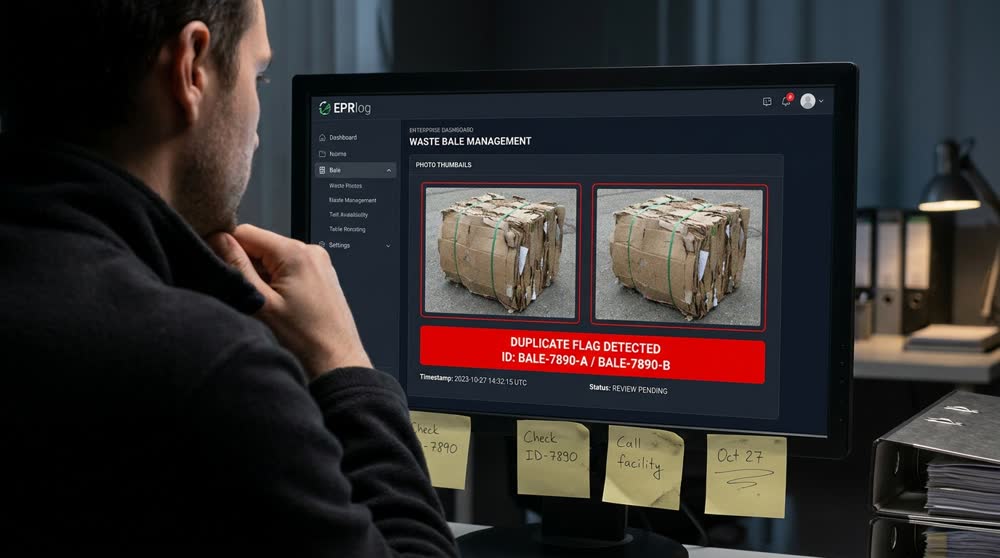
Every photo is hashed against the whole network the moment it lands. It is mathematically impossible to submit the same bale twice - not by your crew, not by anyone else. Zero ghost tonnage.
Three steps. Zero effort.
Hash on arrival
Every photo is fingerprinted the moment it is submitted - cropping, re-shooting the print or tweaking pixels does not change the match.
Check the network
The fingerprint is compared against every photo ever submitted across the whole network, not just your own sites.
Flag and block
A match blocks the submission and flags both records for review. The duplicate never reaches your filing.
What this buys you.
Zero ghost tonnage
Claims only contain material that physically existed once.
Cross-contractor safety
The same bale cannot be claimed by two different contractors either.
Audit confidence
Your filed tonnage survives the hardest question: did this bale exist, once?
Straight answers.
What if someone re-photographs the same bale from another angle?
Angle changes are caught by the layered checks: photo fingerprint plus geo, time, kiosk identity and weight coherence. Suspicious near-matches are flagged for human review in the staging vault.
Does this slow down submissions?
No. Hashing and matching run in the pipeline; honest submissions are unaffected.
Why not use AI to classify material instead?
Classification can be argued with; a duplicate fingerprint cannot. EPRlog prefers evidence that is mathematically checkable over model opinions.
Who are you
Tell us who we are talking to.